
The Database Enhancement Gateway: The Power of Collective Voice in Collision Repair
By: Danny Gredinberg, DEG Administrator, www.DEGWEB.org
In collision repair, accuracy is vital to business sustainability. For years, data estimation has lagged behind rapidly evolving vehicle technologies.
Enter the Database Enhancement Gateway (DEG). Established in 2007 from a series of industry meetings and developed with the help of groups such as the Society of Collision Repair Specialists (SCRS), Automotive Service Association (ASA), Alliance of Automotive Service Providers (AASP), and multiple industry sponsors, the DEG was created to make sure that the estimating data used in shops matches the actual work needed. (Estimating data refers to labor times and costs used by shops for repairs.)
A recent DEG inquiry 40734 regarding the 2022-2026 Mercedes-Benz W206 C300 serves as a perfect “smoking gun” for why the DEG is vital.
The Discrepancy
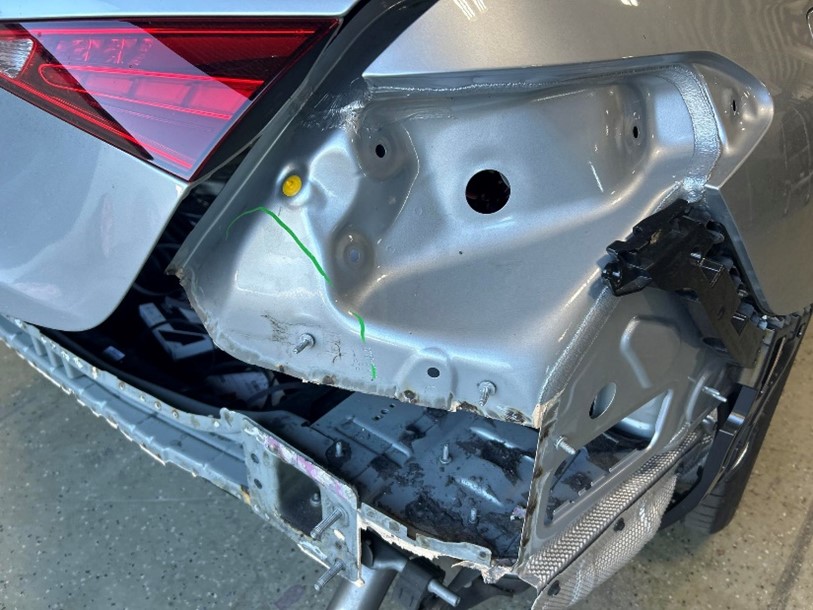
A repairer using CCC estimating software (a tool shops use to estimate labor and parts costs) noticed that the labor time allocated for a rear body panel replacement seemed too low based on the actual requirements set by the Original Equipment Manufacturer (OEM) and the labor guidelines from MOTOR, a provider of repair information. The technical complexity of the W206 chassis (the car’s underbody structure) requires specific steps that the initial database didn’t fully recognize.
The Intervention
The repairer sent an inquiry through DEG. DEG connected directly with Information Providers. A labor data analyst reviewed the case.
The Result
“Estimated UM Release Date: 03/17/2026
Proposed Resolution: MOTOR stated:
After review, we have determined the following:
According to the MOTOR Guide To Estimating, Estimated Work Time Premise, Weld through primer (zinc dust) and Rivet Gun Set-Up or Preparation is not included.
Removal/Installation/Transfer of studs was not considered in the estimated work time.
In the Rear Body & Floor group, Rear Body subgroup, the estimated work time applied to the Rear Body Panel has been updated to 17.5 hours from 10.2 hours.”
The “Hidden” Financial Impact
To understand the magnitude of one single DEG inquiry, let’s look at the “lost” value across the industry before this correction was made. If we assume a conservative volume of repairs for this specific part number since the vehicle’s launch in 2022:
600 Rear Body panels installed using the previous 10.2 labor units.
According to Collision Advice & Crash Network, WHO PAYS FOR WHAT? Frame & Mechanical Survey, “Average median non-DRP body labor rate for 2025 is $67.00.“
600(rear body panels) x 7.3 (Net different after correction to 17.5) = 4380 Labor units
4380 x $67 = $293,460
Conclusion: A $293,460 lesson in data accuracy
In this single instance, the DEG’s intervention identified a gap that, had it remained unaddressed, would have resulted in $293,460 in labor value being absorbed by repair facilities as a permanent loss.
This case study proves that the DEG is not just a “suggestion box.” It is a high-ROI tool fueled by industry collaboration and sponsorship. It ensures that when a technician follows OEM procedures, the shop is compensated for the actual work performed. Without the DEG and supporters, the industry would continue to operate on deficits—one car at a time.
Your inquiries don’t just fix your estimate; they fix the industry.